Review of standby bus breaker ratings
The following items are on the standby bus:
(15 Jul updated for Klixon breaker context)
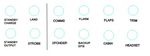
comms (SV-COM-PANEL, SV-COM-T25 0.2A RX 2.0A TX, SV-INTERCOM-2S)
xponder (SV-XPNDR-261 - 0.5A, SV-ADSB-472 - 0.1A)
flarm (Flarm fusion - 0.2A, TrafficView80 - 0.2A)
backup efis (Horis - 0.27A, Magu - 0.025A)
flaps (TCW controller - assume 0.4A, DLA-12-20-A-100-POT actuator 2.6A -> assume 3A total)
cabin (allow 0.1A)
trim (T2-7A 0.15A, 0.9A stall)
headset (allow 0.1A)
total = 2.345A when receiving, no flap actuations, rising to 6.745A when transmitting and actuating flaps
Given 6AH IBBS and assuming EFIS runs of private backup, over 2 hours of operation assuming only occasional transmitting and flap actuation, if the EFIS is run from its own private backup
SV-BAT-320 (1.00A when charging, 4.4AH capacity)
These items are powered from the EFIS
SV-GPS-2020 (0.10A)
SV-ADAHRS-200 (0.15A)
SV-EMS-220 (0.11A)
SV-AP-PANEL (0.05A)
SV-MAG-236 (0.15A)
SV-HDX-1100 2.4A
Total = 2.96A, 3.96A when SV-BAT-320 charging
So if EFIS is powered from the standby bus, total current draw is 2.96A + 2.345A = 5.305A when receiving, no flap actuations, rising to 6.305A when charging the SV-BAT-320 rising to 9.705A when transmitting and actuating flaps and rising to 10.705A when charging the SV-BAT-320
This falls inside the limits (8A steady) of the the IBBS if the EFIS is turned "on", so long as the transmit and flap actuation periods are limited.
If the EFIS is turned "off" and operates of its own standby battery, it will run from the SV-BAT-320 for 4.4/2.96 = 1.5 hours
So a good policy a mixed approach, run from the IBBS then transition to the EFIS backup, then maybe back to the IBBS for final comms, trim and flap requirements.
So in summary a breaker rating of 10A seems appropriate
From the Klixon 2TC2 data sheet
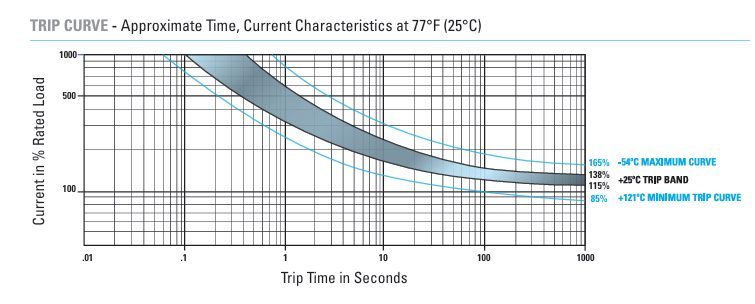
From the IBBS 6AH manual

Author


This post is from Adam Dickson