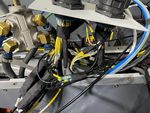
HDP20 pin assignments - finalisation
So I am going to insert the pins, after swapping the engine control (start, magneto, etc) flaps and trim, to the front connector to get them far away from the audio stuff and because the engine control lines are a little short. I am also not inserting the magnetometer lines, deciding to route the magnetometer cable (with its own plug) all the way to the panel. 4 pins are freed up, and I do not have to address the question of whether or not the +12 auxillary power is actually required by the magnetometer. I did not include it. Online discussion says it is not included, but I have learned to distrust such forum talk, or worse, AI. Little is gained by including the magnetometer into the midsection interconnect, and by keeping it separate will facilitate debugging of any subsequent network issues, by enabling the servos to be fully separated from the rest of the network including the magnetometer. I also don't have to redo a bunch of cable splices. In addition, the backup EFIS, likely a Kanardia Horis, will have its own CAN bus-based remote magnetometer. This will be also connected by a cable which will pass directly from the panel though the midsection, also bypassing the interconnect. For this particular cable, there are two reasons for bypassing the interconnect. The first is that the CAN bus has a controlled impedance transmission line, which could be disrupted by being passed through the interconnect. Second, there are just not enough spare wires. Some pins could be liberated by consolidating a shield or two, or a ground, but the payoff does not seem so great merely in the pursuit of "purity" (i.e. everything passing thought the interconnect). Hell, the pitot static lines don't, so I am not going to get bent out of shape about two rather than one electrical cables not passing though the interconnect.
I also added 2 lines for the fuel pump, which I had forgotten about. I will use shielded tefzel for this, so 3 pins required
I have also swapped the backup battery input and outputs between the connectors
So the revised scheme is this:
Cable jackets correspond to subheading names
Individual wire labels correspond to to names alongside the bracketed pin numbers
Connector A (front)
Taxi lights
- 2 size 16 pins,
- pos (34)
- neg (4)
- shld to be aggregated
IBBS battery (shared with B connector)
- 3 size 16 pins (13A rating)
- backup out (4 20AWG wires from DB15 condensed into 1 pin) (6) 20AWG orange wires combined into a white 16AWG wire
- backup gnd (3 20AWG wires from DB15 wires condensed into 1 pin) (1) 20AWG black wires combined into a white 16AWG wire
- pass-thru (3 20AWG wires from DB15 wires condensed into 1 pin) (5) 20AWG red wires combined into a white 16AWG wire
- this connection may not actually be used, if it is decided that the pass-through function of the backup battery is not utilised
- 2 size 20 pins
- charge/sense (17) white wire
- backup master (7) green wire
The backup battery master is only one of two lines that will be live even if the main bus is dead. And this live output will be on a visible pin. By placing the backup power master on the same connector, then if this connector is decoupled the backup battery master pin will be dead.
The low volt warning signal (blue wire on pin 3 of the DB15) and the batt info signal (red wire on pin 2 of the DB15) are passed directly to the EMS220
Tail ADS B-In
- 2 size 20 pins
- serial rx (32)
- serial tx (19)
Transponder
- 2 size 20 pins
- serial rx (47)
- serial tx (33)
Tail ADS B-in/Transponder
- 2 size 20 pins
- pwr (18)
- gnd (31)
Stick
- 5 size 20 pins (AP disconnect omitted)
- lh trim up (20) green wire
- lh trim down (35) red wire
- rh trim up (9) green wire
- rh trim down (8) red wire
- stick gnd (2) black wire
Servos
- 6 size 20 pins, (2 purple band)
- 20 AWG pos and neg wires are combined into single 18AWG wires, using purple band pins
- pos (10)
- neg (22)
- net 1a (3)
- net 1b (11)
- net 2a (37)
- net 2b (23)
Ignition
- 4 size 20 pins(purple band)
- ignition gnd A (30)
- ignition gnd B (45)
- common shield (connected to intake manifold) (29)
- separately run 18AWG ground return (redundancy wire for common shield) (16)
Start contactor
- 1 size 20 pin (purple band)
- start (pull up) (27)
Master contactor
- 1 size 20 pin (purple band)
- master (15)
If this connector is unplugged the pin will be at the battery voltage. But shorting protection is not required as this will be the bottom end of the master contactor coil. This pin is meant to be grounded to close the master contactor
Regulator enable
- 1 size 20 pin
- reg enable (41)
Alternator undervoltage/CSF indicator
- no longer taken through midsection interconnect, routed direct to EMS220
Battery fault indicator
- no longer taken through midsection interconnect, routed direct to EMS220
Flap control
- 5 size 20 pins
- pos (24) white wire
- gnd (38) black wire
- flap up (12) blue wire
- flap down (39) brown wire
- airspeed (25) white/black wire
EFIS main power
- the supply to the EFIS, limited by its CB
- high side for the EMS220 warning light output (low side is EMS220 warning light output)
- the main bus voltage monitored by the EMS220
- 1 size 20 pin
- main voltage (13)
EMS220 warning light output
- 1 size 20 pin
- ext alarm (40)
EMS gnd reference
- 1 size 20 pin
- EMS gnd ref (26)
Headset power
- 1 size 20 pin
- headset pwr (21)
- this might have its own CB rather than sharing the COM radio power CB, for added system safety
Fuel pump
- 2 size 20 pins (purple band)
- pos (28)
- neg (42)
- shld to be aggregated
Trim
- 2 size 20 pins
- red (44)
- grn (43)
A subtotal
Keying pins: 3 size 20
Signal/pwr pins: 39 size 20, 5 size 16
All size 16 and size 20 pins used
Connector B (aft)
Landing lights
- 3 size 16 pins
- lh pos (4)
- rh pos (6)
- neg (5)
- shld to be aggregated
Nav/strobe lights
- 6 size 20 pins (purple band)
- nav pos (11)
- wing strb pos (10)
- tail strb pos (23)
- wing sync (37)
- tail sync (36)
- neg (3)
- shld to be aggregated
USB
- 1 size 16 pin and 1 size 20 pin (purple band)
- pos (35)
- neg (34)
- shld to be aggregated
GPS2020
- 4 size 20 pins
- plus8v (19)
- gnd (17)
- serial rx (2)
- serial tx (7)
Flarm fusion
- 3 size 20 pins
- serial tx (12)
- pwr (39)
- gnd (25)
COM radio
- 5 size 20 pins
- gnd (14)
- pwr (26)
- enable (15)
- data rx (13)
- data tx (40)
Intercom
- 6 size 20 pins,
- audio left (44)
- audio right (17)
- audio gnd (45)
- pwr (18)
- gnd (30)
- dim (46)
Left wing OAT
- 3 size 20 pins
- signal (27)
- pwr (42)
- gnd (28)
Right wing OAT
- 2 size 20 pins
- (43)
- (16)
ELT beacon
- 4 size 20 pins
- elt rx (9)
- rmt sw (21)
- ext on (20)
- gnd+shld aggregated (8)
Overhead lights
- 3 size 20 pins,
- white gnd (33)
- red gnd (47)
- plus 12-16V (32)
- plus 12-16V line is connected to PWM dimmer control output
- white and red gnds are switch-connected to gnd bus
Compass light
- 2 size 20 pins
- pos (38)
- connected to overhead lights PWM dimmer output OR input, all on "interior lighting" CB depending on whether compass light is respectively dimmable or not
- neg (24)
- connected to gnd bus (compass light is incandescent so polarity does not matter)
Aggregated Shield
- 1 size 16 pin, chosen to handle the maximum fault current from a single positive to shield short
- combines shields from both connectors A and B
- (1)
B subtotal
Keying pins: 3 size 20
Signal/pwr pins: 39 size 20, 5 size 16
All size 16 and size 20 pins used
Wires routed from firewall forward and backup battery direct to EMS220
- Alternator undervoltage/CSF indicator. If routed to general purpose input will need a 10k series resistor, if routed to an enhanced general purpose input no resistor needed
- Battery fault indicator
- Backup battery low volt
- Backup battery voltage
The main bus voltage monitored by the EMS220 is the EFIS supply voltage, now routed through the interconnect
And the EMS220 ext fault line is routed back to the midsection interconnect
14 Apr 2026
I have aggregated the shields of the 18AWG looms on interconnect B. The size 20 shield pin is rated to carry a fault current from one of the three circuits, in the event of a short from the pos line on any one of the looms to its shielding. This is a compromise. Previously each loom had its own shield path of which the associated size 20 (or 16) pin is rated to carry the full CB rated load associated with a short from the pos line to the shielding. I will give this more thought.
At this stage the near strict star-pointing of gnd lines has been preserved, although departing from this would be alternate means of recovering signals, as well as reducing the number of keying pins
15 Apr 2026
Above scheme dumped. Instead, I combine the neg and shields before passing through the midsection interconnect. In most cases I will be dumping shielding for the final run between the interconnect and the panel. This frees up some pins for added flexibility. I might separate out the tail beacon strobe function from the wingtip strobes. I have also increased the flexibility of the compass lighting, allowing it to be powered either from a interior lighting circuit main bus or from the dimming PWM output. I have also combined the magneto ground path with the shield at the interconnect, allowing the use of a single pin. Both the magneto and ELT will employ shielding for the final run to the panel
19 Apr 2026
Magneto ground return kept separate from shield at present, for added redundancy against wire breakage
Pitot heat active signal restored, since the EMS220 now monitors this
21 Apr 2026
Dump the pitot heat active signal, restore the low voltage detect from the IBBS, based on a revised understanding that this signal warns of a low INPUT voltage to the IBBS. This may occur, and be otherwise undetected, if the CB to the IBBS is popped and not noticed. So overall, the pitot heat wiring can probably be removed
25 Apr 2026
Add a headset power line
Pitot heat cable dumped
Add wires for compass light
28 Apr 2026
Assign wires to HDP20 pin locations
30 Apr 2026
Update documentation with pin locations
May 9
Connector A pins were rearranged leading to damage of the connector. This was replaced, pins were reassigned. Table above is updated.
May 19
It was realised that appropriate use of the tail strobe requires its wiring to be decoupled from the wing strobe. When taxiing it is preferable not to strobe the wingtips, but only the tail strobe. Therefore it is necessary to separate out the tail light strobe line onto a separate pin. But if the tail and the wing strobes are not simultaneously powered, the wing strobe sync lines probably be decoupled from the tail sync line in order not to do damage, as inferred from the data sheet comment that the sync line should be connected to neither ground nor +12V. If the wing strobes are unpowered, probable parasitic conduction will probable have the effect of shorting the tail sync - if connected - to effectively ground, and vice-versa. So it is necessary to bring the combined wing syncs and the tail sync to two separate pins. However there are just two spare size 20 pins and two spare size 16 pins on connector B. So the USB power lines are moved onto the spare size 16 pins, leaving 4 spare size 20 pins. 3 of these pins will be used as follows: (separated) tail strobe power, wing sync, tail sync. The wing and tail nav power line is kept combined, as these will always operate together. Switches, and possibly a solid state relay, located at the panel will correctly bond the two sync lines only when both the tail and wing strobes are operating. The table above has not been updated to reflect these changes. With these changes applied, there remains a single size 20 pin.
May 19
I am considering the validity of the neg/shld aggregation that has been performed for 7 groups of shielded cables. Previously, the shields of each group of shielded cables were separately run though dedicated pins in the interconnect. The panel loom would continue these wires all the way to the negative busbar either as separate wires or if the shielded cables were continued in the panel loom, as the continuation of the shield. Either way all the shields would be combined at a single potential point. By combining the shields with the negative lines at the midsection interconnect, then due to the impedance of the combined negative/shield wire running back to the negative busbar, a potential difference could develop between the respective shield groups. This potential could have significant RF components. These shields then lie if close proximity over extended lengths in the centre and rear fuselage. Capacitive coupling between the shield groups could then couple the shielded circuits together to some degree. Does this matter? There is a voltage division effect between this capacitive coupling and the impedance of the relatively short aggregated shield/negative lines running back to the negative busbar. This might greatly mitigate any consequences. From another point of view, does the slight potential picked up by the entire shield, relative to the ground bus, matter? Any audio lines in the aircraft are also fully shielded. This begs the question: what is the point of all the shielding in the wings and the rear fuselage anyway? Is it because the lights are all based on switchmode supplies, and consequently may have significant RF components in their current draw? If that is a problem, then the ground block is not going to magically suppress any consequences if the shield are not perfectly star-pointed. The real solution is RF decoupling preferably as close as possible to the light, or at the very least at - for example - the wing interconnects, or even the midsection interconnect. Most other lines in the aircraft - albeit relatively low current - are not shielded.
If I were to de-aggregate the shield and negative lines, I would need additional pins. Most probably I would need to introduce an additional midsection connector. Alternatively I could just have a floating plug/socket dedicated to the shields, although this is a bit of a hack. I do not have much space to fit additional panel connectors. I previously kept to the idea of the shield returns having the same current carrying capacity as the respective positive lines. The reason for this is if the cable develops an internal short of pos to shield, I do not want overly thin shield lines to burn out, in lieu of popping the respective circuit breaker. One solution is to deaggregate all the shield lines at the midsection interconnect, combine them into a single dedicated pin with current capability equal to the largest CB involved in supplying the shielded lines. This single line is then run back to the ground bus. Another approach - if a high current pin is not available - is to run the combined shield back to the ground bus via a low-value circuit breaker. This circuit breaker - when popped - would reveal positive to shield shorts. I kind of like this idea.
The aggregated gnd/shld of the ELT beacon can be left in place, as this gnd line is not carrying significant current.
So, to summarize the gnd/shld aggregation
Connector A
- Taxi lights
- Fuel pump
Connector B
- Landing lights
- Nav/strb lights
- USB
The 5 separated shield wires could be combined and run through the spare pin on connector B. Alternatively, a pin could be freed up an connector A (such as airspeed) and shield wires on the respective connectors could be implemented. This or these wires would run back to the grounding block, via a panel CB.
All of this presupposes the non-use of shielded cables in the panel loom. These seems little point in this, because so much of the individual current paths are necessarily exposed, particularly the positive wire which runs through the switches then across to the CBs and then onto the positive busbar. The negative lines run straight to the negative busbar. So there is no point in getting religious or OCD about all of this shielding business. The shielded cable was supplied, and I used it, and it is here to stay. I have managed the shielding appropriately, but I have decided there is no point in continuing it past the midsection interconnect, and this decision still looks good.
So what I will do is de-aggregate the shield and negative lines, combined all the shields and pass them though the one remaining size 20 pin. This will then run to the negative busbar via a low current panel CB. The advantage of this is I do not have to disturb all the HDP20 pin placements, I do not have to introduce a new connector, and all of the sketchy RF considerations raised earlier are addressed. Further there is a detection - via the shield CB - of certain modes of cable failure.
May 22
On connector B move the USB to the 2 spare size 16 pins, this leaves 4 spare size 20 pins. Three of these are used by the revised Nav/strobe setup. The one remaining pin is used for the aggregated shield, across both connectors.
May 23
New pins assigned. The two USB pins are size 16 and size 20. I could have made both size 20 for uniformity's sake, by stealing one of the keying pins, and using the now-spare size 16 pin location as a keying pin. However, the size 16 keying pin would be right near one of the other size 20 keying pins, and I prefer such locations to be uniformly spread out. So I did not bother about this. For the ELT the shield is left connected to the negative wire, and not aggregated with the other shields. I have considered dumping the shield pin for the ignition wire, and relying on the "backup" engine ground wire. If this were done this would free up a pin. For now, I am going to use both, for redundancy. As it is all pins are now used, on both connectors. The only way to free up more pins would be to review the following options
- Dispense with one or two keying pins, not all three. Across both connectors this would free up 4 pins
- Decide whether the compass light is powered from the PWM dimmer output of the the rail voltage (PWM input). This would free up 1 pin
- Decide whether to dispense with the ignition wire shield connection, instead relaying purely on the "backup" engine ground wire. This would free up 1 pin.
For the moment I am running the aggregated shield though a size 16 pin and not including any CB in series in the panel. In the event of a pos to shield short on any of the power-carrying shielded cables, this pin and the associated wiring will have at least the same current carrying capacity as the power circuits themselves. So the shield wiring will also be fully protected by the associated CB. In the event of a CB tripping, it will be possible to confirm or disprove the cause is a positive-to-shield short by continuity testing at the unplugged midsection interconnect. Continuity testing can also identify negative-to-shield shorts if these are suspected
Author

Decoupling of wingtip and tail strobe
This post is from Adam Dickson